Would you like to find out what our satisfied customers have to say about us? We would be happy to arrange an appointment with you to talk to one of the more than 250 renowned companies that rely on apsolut's specialist knowledge and IT expertise.





When Göktürk Simsekol took over indirect procurement at MKS | Atotech, SAP Ariba was already in place. Purchase orders were flowing through the system, a partner supported operations, and the foundation for digital procurement had been established. The opportunity was clear: unlock the platform's full potential and transform it into a truly global procurement engine.
What followed was far more than a system optimisation project. It became a journey of continuous improvement and organisational transformation, driven by a shared vision between MKS | Atotech and apsolut.
The starting point offered tremendous potential. With more than 68,000 suppliers in the database and procurement processes spanning multiple regions and business units, the organisation had the scale and complexity that called for a more streamlined, transparent, and standardised approach. Increasing system adoption, strengthening governance, and creating greater visibility across indirect spend became key priorities.
When evaluating the path forward, MKS | Atotech considered several options, including additional external support models and a continuation of existing approaches. What ultimately stood out about apsolut was not simply technical expertise, but deep procurement experience and a strong commitment to knowledge transfer.
Göktürk had worked with apsolut before and knew the value of their approach. Rather than simply implementing solutions, apsolut focused on building internal capabilities. The goal from the beginning was clear: create a sustainable procurement organisation that could continuously improve and evolve long after go-live.
Before new processes could be designed, the team invested significant time in understanding the existing procurement landscape. Together, Göktürk, Lisa Reese (Senior Head of Ariba Content & Governance), and Marisa Pena (Senior Manager Supplier Risk and Sustainable Procurement) mapped workflows, approval structures, supplier onboarding processes, and finance integrations. It was a collaborative effort focused not on identifying shortcomings, but on uncovering opportunities to simplify processes, strengthen governance, and improve the user experience.
Some of the best ideas emerged during informal discussions. On one memorable evening, when the conversation moved faster than the available meeting materials, ideas were captured on cocktail napkins. Those sketches became the starting point for many of the concepts that would later be formalised through workshops, whiteboards, and working sessions. One of those original napkins still hangs on the wall today, serving as a reminder that transformation often starts with a simple conversation.
Throughout the journey, apsolut acted as an enabler, combining deep technical expertise with the practical realities of day-to-day procurement operations. Solutions were developed together, refined iteratively, and continuously adjusted based on experience and feedback.
The collaboration also created significant opportunities for individual growth. Lisa, who became one of the strongest advocates for improving the Ariba experience, helped build and expand the platform's catalogue and content structure into a scalable framework supporting the organisation's indirect procurement needs. Marisa led the development of purchasing excellence standards, translating complex procurement policies into practical guidance designed to remain relevant for years to come. Göktürk provided the strategic direction, ensuring that processes, governance, and technology evolved together towards a common vision.
As knowledge and expertise grew within the organisation, the partnership became increasingly collaborative. Team members were not only learning from apsolut but also contributing new ideas, configurations, and approaches that enriched the overall solution. The exchange of knowledge became a true two-way street.
One of the most impactful outcomes was the establishment of clear ownership and accountability. A global "No PO, No Pay" policy reinforced procurement compliance and standardised purchasing practices across the organisation. Combined with a robust vendor management framework, it created greater transparency, increased process consistency, and ensured procurement was engaged at the right stages of supplier onboarding and purchasing decisions.
The system was rebuilt to reflect that ambition. GL account mapping eliminated the guesswork from requisitioners. Rather than expecting Ariba users to think like accountants, the team created a UNSPSC-to-GL mapping that automatically assigned the correct account. Approval workflows were redesigned to ensure that the right decisions reached the right stakeholders at the right time. Custom forms addressed business scenarios that standard Ariba functionality could not fully support, including payment term changes, price escalations, emergency purchases, and one-time vendor requests. SAP Ariba's Supplier Lifecycle and Performance module was comprehensively redesigned to support structured supplier onboarding, risk screening, and Code of Conduct acceptance.
Technology alone, however, was never the objective. Success depended on people adopting new ways of working and understanding the value behind the changes. In 2025 alone, the team delivered approximately 300 hours of training across the organisation in multiple languages. Attendance for requesters was mandatory. Short video tutorials replaced lengthy presentation decks, while a dedicated internal knowledge hub provided a single source of truth for policies, reporting, guidance, and best practices. The focus was not simply on teaching users how to navigate a system, but on building procurement knowledge and creating confidence in new processes.
Over time, that investment in capability building began to pay dividends. As users became more familiar with the platform and procurement governance became embedded in daily operations, adoption increased significantly. Teams across the business developed a stronger understanding of their role within the procurement process, creating greater consistency, transparency, and accountability.
The results are not a projection. They are on the scorecard.
As of February 2026, MKS | Atotech's procurement function records 0% non-PO invoice spend, 99.9% of requisition spend created from catalogues, compared with an industry top-quartile benchmark of 75%, and ad hoc requisition spend of just 0.04%. Every metric places MKS | Atotech at or beyond the top quartile of its industry peers.
Behind those numbers sits a savings trajectory that tells its own story. In the years before the transformation, annual savings from indirect procurement were low. Last year, that figure grew significantly - to approximately ten times the starting point.
During the same period, the supplier base was streamlined from more than 68,000 active supplier records to approximately 6,000, significantly improving governance, supplier visibility, and operational efficiency.
Yet perhaps the most meaningful outcome cannot be measured in percentages or dollars. The procurement organisation itself evolved. A team that once spent much of its time administering transactions now spends far more time creating value through strategic sourcing, supplier management, risk mitigation, and business partnership.
Lisa Reese, who worked in procurement before taking responsibility for the Ariba team, reflects on that transformation simply:
"Finally, I can see the value I provide to the organisation."
That statement captures one of the most important achievements of the journey. The transformation was never solely about implementing technology. It was about creating an environment where people could contribute at a higher level, develop new capabilities, and focus their expertise on activities that generate lasting business value.
The work, however, is far from finished. Göktürk Simsekol is the first to say so.
Guided Buying has reached the level of maturity the team envisioned, but opportunities remain within Sourcing and Supplier Lifecycle and Performance. Supplier login challenges, usability improvements, and functionality enhancements continue to be addressed jointly with apsolut before additional modules are deployed. Looking ahead, supply chain collaboration enabled through SAP Business Network represents the next major milestone.
The sequencing is intentional.
"I don't want to create another construction area before the others are well managed," Göktürk explains. "First, we have to finish what we have."
That philosophy has shaped the partnership from the beginning. Every phase has focused on building a strong foundation before expanding further. Rather than pursuing rapid growth for its own sake, MKS | Atotech and apsolut have prioritised sustainable progress, user adoption, process excellence, and organisational readiness.
What MKS | Atotech and apsolut have built together is not a finished product. It is a continuously evolving capability. The technology provides the platform, but the real value comes from the people, processes, and knowledge that have been developed around it.
The true success of the transformation lies in the partnership itself: a shared commitment to learning, continuous improvement, and long-term value creation. Over the years, the relationship evolved from implementation support into a collaborative exchange of expertise, where both organisations contributed ideas, challenged assumptions, and worked together to solve complex business problems.
Today, MKS | Atotech has more than a modern procurement platform. It has a procurement organisation equipped with the capabilities, governance, and internal expertise required to adapt, scale, and continue improving for years to come.
What began as an effort to optimise SAP Ariba evolved into something far larger than a technology project. It became a blueprint for how strong partnerships, empowered people, and continuous improvement can transform an organisation. Together, MKS | Atotech and apsolut created not only a worldclass procurement platform, but also the foundation for future innovation, sustainable growth, and lasting business value.
11,000
employees worldwide. That is the reach of the procurement policy developed by MKS | Atotech's indirect procurement team, adopted as the global standard across all MKS Instruments divisions.

The blueprint for MKS | Atotech's procurement transformation was not drawn up in a conference room. One evening, cocktail napkins had to do. The thoughts captured on them turned out to be decisive. One of the original napkins is still pinned to the wall.





Would you like to find out what our satisfied customers have to say about us? We would be happy to arrange an appointment with you to talk to one of the more than 250 renowned companies that rely on apsolut's specialist knowledge and IT expertise.

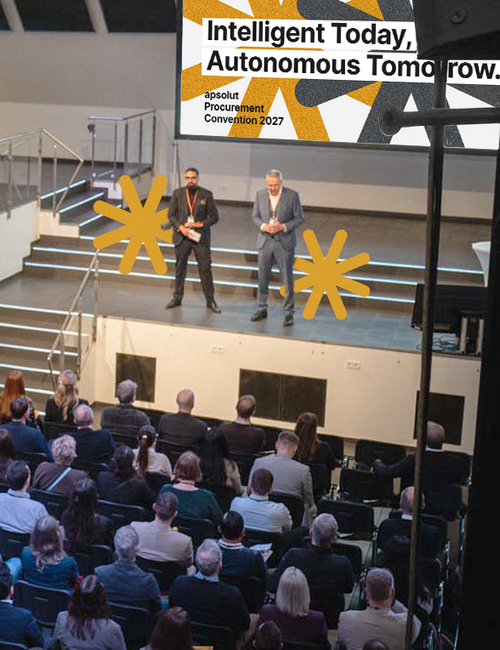
INTELLIGENT TODAY, AUTONOMOUS TOMORROW.

